
Licensing Disability: An Attack on Freedom That Courts Will Crush

Introduction
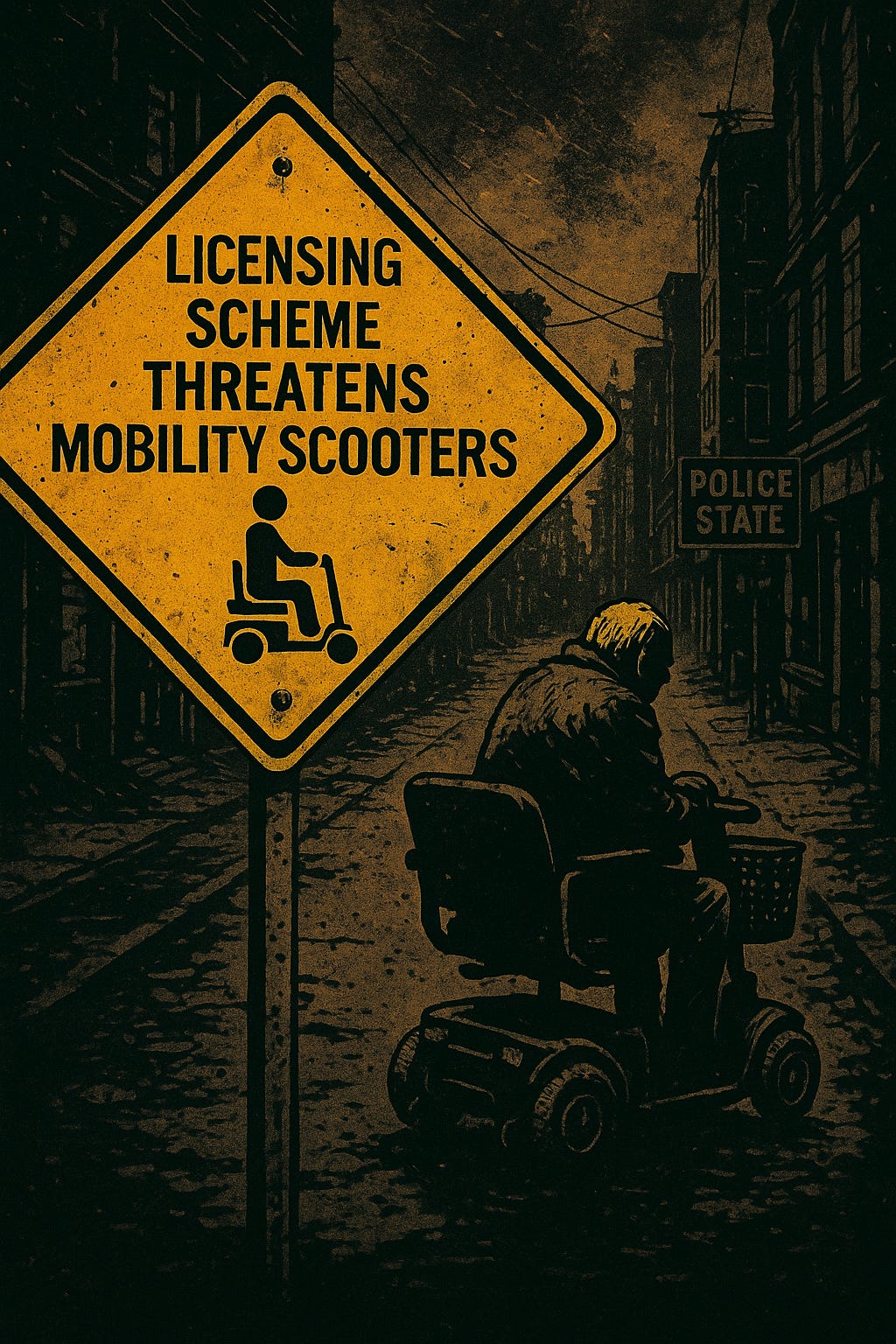
In early 2025, the Cortland City Council in New York sparked controversy when it floated the idea of requiring disabled individuals to apply for licenses or permits to operate mobility scooters within city limits. Supporters of the proposal argued that unregulated scooter use was creating sidewalk congestion, posing safety hazards, and in some cases being misused by non-disabled individuals. Critics, however, quickly noted that such an ordinance would not only stigmatize disabled residents but also almost certainly violate established federal law, particularly the Americans with Disabilities Act (ADA).
Mobility scooters are not recreational vehicles; they are assistive technologies essential for individuals with mobility impairments to participate fully in public life. By forcing disabled people to obtain licenses or permits to use these devices, Cortland’s ordinance would unlawfully burden and restrict access to public spaces. This paper argues that the proposal is discriminatory, unenforceable, fundamentally incompatible with federal civil rights law, and a dangerous erosion of basic liberties.
The Proposal: Cortland’s Licensing Scheme
The ordinance under consideration in Cortland was framed as a public safety measure. City council members pointed to complaints about scooters crowding sidewalks, obstructing storefronts, and creating near-collisions in crosswalks. They also claimed that some individuals who were not disabled had obtained mobility scooters and were using them as casual transportation, blurring the line between medical assistive devices and recreational vehicles.
To address these concerns, the council’s proposal suggested:
Licensing Requirement – Disabled individuals would need to apply for a city-issued license to operate a mobility scooter.
Medical Verification – Applicants would be required to submit documentation from a physician proving medical necessity.
Permit Display – Scooters would be marked with a visible permit sticker or tag, allowing enforcement officers to check compliance.
Enforcement Mechanism – Police or city code enforcement officers would be empowered to stop scooter users, request proof of licensing, and issue fines for noncompliance.
On its face, the proposal attempts to distinguish between “legitimate” and “illegitimate” scooter users. But in practice, it would create an intrusive bureaucracy that forces disabled residents to prove their medical status to the government before accessing public space. It also presumes guilt — treating every scooter user as a suspect until proven disabled.
The Legal Status of Mobility Scooters
Mobility scooters and power wheelchairs are legally recognized as assistive devices, not motor vehicles. Under the ADA and subsequent Department of Justice (DOJ) regulations, individuals with disabilities must be allowed to use mobility devices in public areas, including sidewalks, crosswalks, government buildings, and commercial spaces.
The ADA distinguishes between:
Manual wheelchairs and mobility scooters — explicitly protected devices.
Other power-driven mobility devices (OPDMDs) like Segways — conditionally allowed if reasonable.
Because mobility scooters fall in the first category, cities and municipalities cannot impose burdensome restrictions on their use. Courts have repeatedly affirmed that any attempt to limit access to public spaces for people using assistive devices amounts to a violation of federal law.
The Americans with Disabilities Act (ADA)
The ADA of 1990 is the central federal law governing disability rights. It prohibits state and local governments (Title II) and businesses/public accommodations (Title III) from discriminating against people with disabilities.
Requiring disabled individuals to apply for licenses or permits to use mobility scooters would violate multiple sections of the ADA:
Equal Access to Public Spaces (Title II)
Public entities must ensure that people with disabilities can access sidewalks, streets, parks, and other public infrastructure. A licensing requirement would place an additional barrier to access not imposed on able-bodied pedestrians.
Prohibition on Unnecessary Documentation
The DOJ has clarified that entities may not require disabled people to carry special IDs or certifications to prove their disability. Requiring a license to use a mobility scooter is functionally equivalent to demanding proof of disability.
Integration Mandate
The ADA requires public entities to administer services and facilities in the most integrated setting possible. Singling out disabled people for special licensing undermines this principle by treating them as exceptions to normal pedestrian use.
In short, the ADA requires cities like Cortland to remove barriers, not create new ones.
The Rehabilitation Act of 1973
Before the ADA, the Rehabilitation Act (Section 504) prohibited discrimination on the basis of disability in programs receiving federal funds. Because nearly all municipalities — including Cortland — receive some form of federal funding, the ordinance would likely run afoul of Section 504 as well.
Courts have ruled consistently that policies restricting mobility devices deny “meaningful access” to public programs and services. For example, in Tennessee v. Lane (2004), the Supreme Court reaffirmed that the right to access public spaces is a fundamental constitutional guarantee. Cortland’s ordinance would directly undermine this right.
Case Law Precedents
Several cases demonstrate that licensing requirements or unnecessary restrictions on assistive devices cannot survive legal scrutiny:
Department of Justice v. Uber (2022) – DOJ ruled that charging wheelchair users wait-time fees was discriminatory, reinforcing that disabled people cannot face added burdens for accessing public services.
Brown v. District of Columbia (1995) – A city ordinance limiting motorized wheelchair access to sidewalks was struck down as a violation of the ADA.
Spector v. Norwegian Cruise Line Ltd. (2005) – The Court held that accessibility obligations extend broadly and cannot be avoided through technicalities.
These cases suggest that Cortland would almost certainly face lawsuits and lose if it pursued its licensing proposal.
Why Lawsuits Are Inevitable
If Cortland proceeds with this ordinance, lawsuits would not be a distant possibility — they would be an immediate reality. Disability rights law is one of the most aggressively enforced areas of civil rights in the United States, and advocates are both well-funded and highly organized. The moment Cortland enacts a scooter licensing requirement, it will find itself in the crosshairs of lawsuits from multiple fronts:
Private lawsuits from disabled residents demanding damages.
DOJ enforcement actions resulting in federal consent decrees.
Class action litigation organized by advocacy groups.
Loss of federal funding tied to Section 504 violations.
Put plainly: if Cortland passes this ordinance, it will be sued — and it will lose.
An Erosion of Civil Liberties
Beyond the legal violations, this ordinance represents a disturbing erosion of civil liberties. It singles out a group of people defined not by choice, but by circumstance, and imposes restrictions on them that no able-bodied individual would ever face. A person with strong legs can walk down Cortland’s sidewalks without carrying identification or proving their right to be there. A person in a scooter, however, would be treated as suspect — forced to obtain government approval just to exist in public space.
This flips the presumption of liberty on its head. The foundation of American rights is that freedom of movement and access to public life are guaranteed unless one breaks the law. Cortland’s proposal inverts this principle by making disabled people prove they deserve access before they are allowed to move freely.
Disability is not a lifestyle choice or a temporary condition for most individuals. It is a permanent reality, one that requires society to accommodate, not restrict. By targeting disabled residents, the city would be punishing people for circumstances beyond their control — eroding not just statutory rights under the ADA, but the deeper promise of equal citizenship.
This is precisely why Congress passed the ADA in 1990: to ensure that people with disabilities are not treated as second-class citizens. Cortland’s ordinance would be a step backward into an era when disability justified exclusion. That erosion of liberties should alarm not only disabled people but every citizen who values equality under the law.
Practical Problems with the Ordinance
Beyond legality and liberty, Cortland’s proposal is unworkable in practice:
Medical privacy would be compromised.
Police would be asked to act as disability gatekeepers.
Invisible disabilities would be ignored, fueling harassment.
Public spaces would become zones of intimidation, not inclusion.
Why the Safety Argument Falls Flat
The main justification from Cortland officials is safety — but safety can be achieved without criminalizing disability. Reckless users can be penalized under existing traffic laws. Public campaigns can educate about sidewalk courtesy. Recreational e-scooters can be regulated separately. None of these require stripping liberty from disabled residents.
Conclusion
The proposed Cortland ordinance to require licenses for mobility scooters used by disabled residents is not only misguided but also unlawful. Under the Americans with Disabilities Act, the Rehabilitation Act of 1973, and decades of case law, municipalities cannot single out disabled people for special burdens that restrict their access to public life.
If enacted, the ordinance would almost certainly be struck down in court, costing taxpayers money in litigation and harming Cortland’s reputation. More importantly, it would stigmatize and isolate disabled residents, treating assistive technology as a privilege rather than a right. It would erode liberties by targeting people for circumstances they cannot change, marking disabled citizens as less free than their able-bodied neighbors.
The bottom line is clear: if Cortland chooses to fight the ADA, it will lose. The only question is how much money, goodwill, and credibility the city wants to waste before admitting it. The smarter course is to abandon this ordinance before it drags the city into a courtroom it cannot win in and a moral fight it has already lost.
Works Cited
Americans with Disabilities Act of 1990, 42 U.S.C. §12101 et seq.
Brown v. District of Columbia, 928 F. Supp. 355 (D.D.C. 1995).
Department of Justice v. Uber Technologies, Inc., Consent Decree, U.S. District Court for the Northern District of California, 2022.
Rehabilitation Act of 1973, 29 U.S.C. §794.
Spector v. Norwegian Cruise Line Ltd., 545 U.S. 119 (2005).
Tennessee v. Lane, 541 U.S. 509 (2004).
U.S. Department of Justice, Civil Rights Division. “ADA Requirements: Wheelchairs, Mobility Aids, and Other Power-Driven Mobility Devices.” DOJ, updated 2014. https://www.ada.gov/resources/mobility-devices/.
They will try. This will be the first step in moving towards everyone needing “papers”, which will at some point become a digital access code. Eventually, everyone will need their code to do anything at all.